There’s a question almost no business owner can answer today: “How many times has Artificial Intelligence already talked about my business to a potential customer, without me knowing?”
Until a few weeks ago, the answer for everyone was: no idea. Then Google shone a light on this blind spot with a new report inside Search Console. We put it to the test, on our own site and on those of the clients we work with. And the numbers that came out tell a story worth reading to the end, even if you're not in the trade.
First, a point that matters to us. Studio Salatino is a management consulting firm, not an agency that physically writes content or carries out SEO work itself. Our job is to define strategy and goals, coordinate the teams and external suppliers working on content and technical aspects, and analyse the results to change course when needed. What you’re about to read is proof that this method works, not an account of a content-writing service.
What this new report really shows (and what it can't tell you yet)
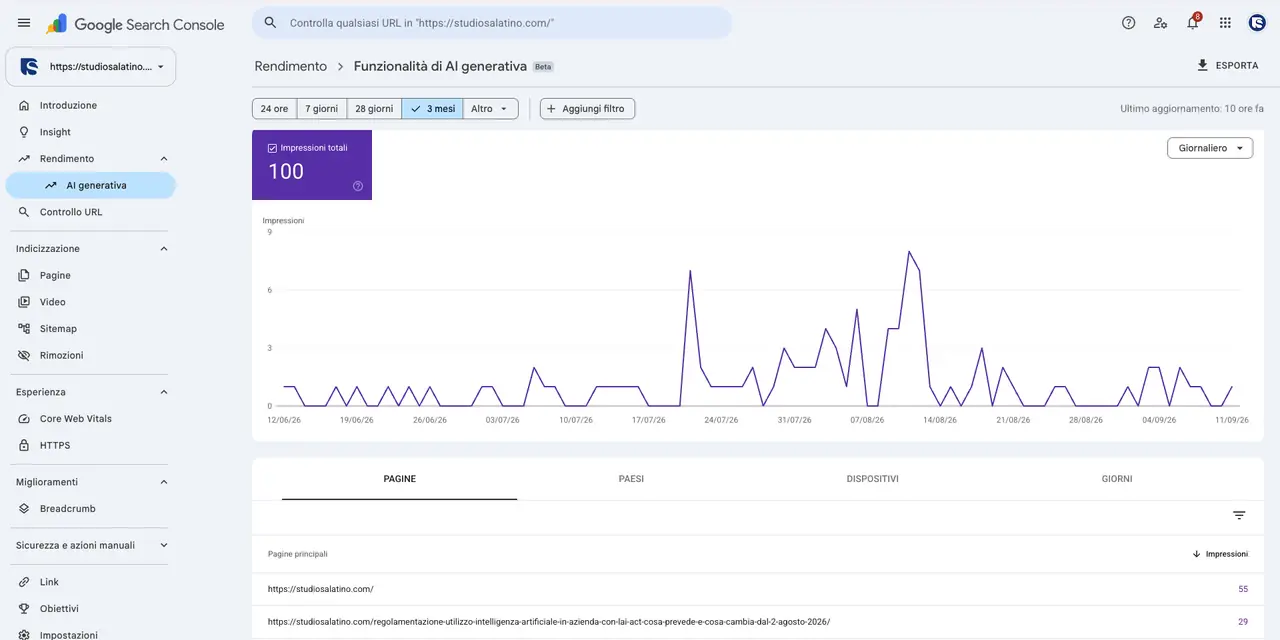
On 3 June 2026 Google launched “Generative AI features”, a new section within Search Console that went live on every site worldwide by 31 August. For the first time, a site can see, with data provided directly by Google, how many times its pages are shown within AI Overviews, AI Mode and Discover’s generative answers.
This is important news. But it needs to be read honestly. The report measures impressions: how many times one of your pages appears within an AI-generated answer. It does not yet measure clicks, the exact questions that triggered it, or position. Knowing you are cited today means knowing you are visible, not yet knowing how much of that visibility turns into a real enquiry. It is one piece, the first, of a puzzle that will be completed in the coming months: the UK’s Competition and Markets Authority (CMA) has already asked Google to add click data by March 2027, a commitment confirmed by Google Search Central itself in the official announcement of the report.
There is, however, something we’ve managed to do in some projects, going beyond what the report alone tells us. By integrating CRM tools such as HubSpot, we have tracked real leads originating from conversations with AI chatbots, recognising referrers from LLMs along the contact’s journey. It doesn’t yet happen the same way everywhere, but it proves something concrete: the path from an AI citation to a business handshake is, in some cases, already measurable today.
Our experiment: 100 impressions in 90 days, starting from almost nothing
On 25 May 2026 we started working on optimising the content of studiosalatino.com. A site with little published content, live for only a few months, born from the evolution of the brand we previously operated under, DIGITAL&MORE. We were not starting from a position of advantage.
Over the following three months, the Search Console report recorded 100 total impressions in generative AI features. Almost all were concentrated on two pages: the homepage, with 55 impressions, and our article on the AI Act and corporate AI Governance, with 29.
It’s not the figure you’d put in a prime-time ad. And that’s exactly why we’re publishing it: because it’s real, measured and, above all, it shows what happens when a young project starts building with a method, instead of firing off random content and hoping something sticks.
And when a site already has years of authority behind it? That's where the numbers move up a gear
The figure really worth looking at isn’t so much the 100 of a brand-new project, but what happens when the same approach is applied to a site that has long had indexed content and an established domain reputation. Over exactly the same three-month period:

- A client running a B2B lead generation programme recorded 10,900 impressions in generative AI features

- A client running a B2C lead generation programme recorded 8,150
From 100 to almost 11,000. This isn’t an isolated feat: it’s the most direct proof that a site’s authority is built over time, with consistency and genuinely useful content, and that the more authoritative material exists online about a company, the more reasons Artificial Intelligence has to cite it instead of a competitor. It’s not a switch you flick on. It’s a trajectory that lengthens, month after month, for those with the patience and the method to follow it.
A clarification we want to make: search is a channel, not the goal
Studio Salatino works on marketing strategy and digital growth as a whole. Organic search, both traditional and generative, is one of the channels that make up a real demand generation system, alongside paid media, email marketing, social media and other touchpoints, chosen case by case according to the client and their goals. The numbers you’ve just read describe one piece of the work. Not all of it.
How we get there: the method behind the numbers
As mentioned, we are not the ones who write the content or physically carry out the SEO work. We coordinate the entire process through a method we apply to every client who decides to embark on a digital growth journey with us.
Marketing Audit. Before any content is touched, we analyse the starting point: existing web presence, site structure, content already published, positioning against competitors and, increasingly today, current visibility in generative engines (even if it’s zero).
Strategy Development and Activity Planning. The audit leads to a tailored editorial and digital communication strategy: pillar topics consistent with the company’s positioning, an editorial calendar, and technical priorities such as site structure, structured data and updating existing content.
KPI and Activity Monitoring and Control. The work doesn’t end at publication. We regularly monitor performance, now including impressions in generative AI features, to understand what really works, correct course when needed and keep building authority over time.
It’s exactly the same method we’re applying, right now, to our own site. And the numbers, while still small, are moving in the right direction.
The questions we're asked most often
What exactly is this new Search Console report? It is the “Generative AI features” section, launched by Google in June 2026, which shows how many times a site’s pages appear within AI Overviews, AI Mode and Discover.
Does it also show clicks coming from AI? Not yet. At the moment, in its Beta version, the report only shows impressions, pages, countries, devices and trends over time. No clicks, no queries, no average position.
How long does it take to start being cited by AI? There is no fixed timeframe. It depends on the domain’s authority, the quantity and quality of content already indexed, and how consistently you publish. Our site started generating its first impressions within the first three months of work.
And your business: how often is it already being cited by AI today?
You probably don’t know. And that’s fine: until a few weeks ago, nobody did. But now that the tool to find out exists, the real question is a different one: do you have a method to make that number grow, or are you hoping it will happen on its own?
If you want to find out where your company stands in generative engines today, and build a practical strategy with us to grow it, the first step is a conversation.
Write to us and tell us where you are
Studio Salatino is a management consulting firm specialising in Strategy, Marketing and Innovation, supporting SMEs in defining strategies and practical actions for digital growth.