Marketing frameworks · Analysis

Porter’s Five Forces

Porter's five forces

by Published on Updated on 6 min readBeginner

When to use it
When you want to understand why margins are under pressure, or before entering a new market.
Origin
Michael Porter, 1979

Key points

  • It measures where the pressure on prices and margins comes from.
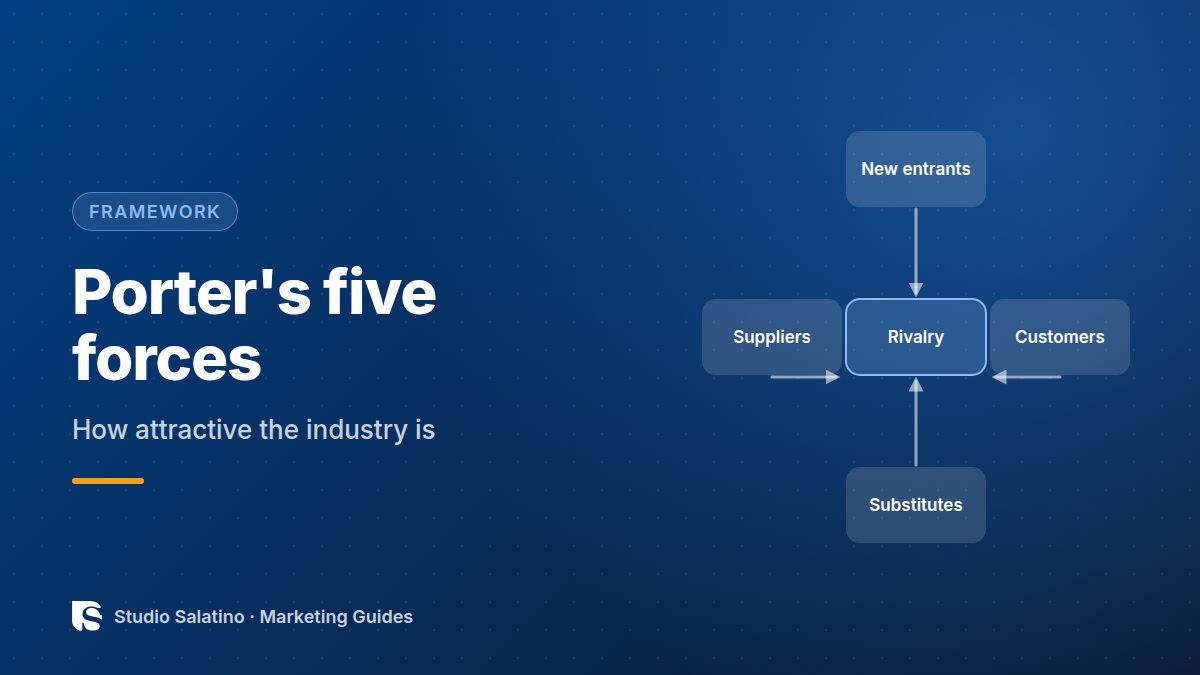
  • Five forces: rivalry, new entrants, substitutes, customers, suppliers.
  • Substitutes meet the same need in a different way.
  • Where the pressure is high, you need concrete defences.

How to apply it, step by step

  1. Define the market

    Clarify the product, the area and the target customers.

  2. Assess each force

    For each of the five forces, estimate the pressure (low, medium, high) and note down the reasons.

  3. Identify the strongest forces

    They are the ones that squeeze prices and margins the most.

  4. Choose your defences

    Differentiation, customer loyalty, more suppliers, barriers built on expertise or reputation.

  5. Link it to your positioning

    The defences you choose shape the value proposition and the plan.

What it is for

Porter’s five forces assess how competitive a market is and where the pressure on prices and margins comes from. They help you understand why it is hard to make money in a sector and where it pays to position yourself.

The five forces

  • Rivalry among competitors: how many there are, how similar they are, how aggressive they are.
  • Threat of new entrants: how easy it is to set up a similar business.
  • Substitute products: different alternatives that meet the same need.
  • Customer power: how much customers can negotiate or switch supplier.
  • Supplier power: how much the business depends on a few key suppliers.

How to read it

For each force you estimate whether the pressure is low, medium or high, and why. Where the pressure is high, you look for defences: differentiating, building customer loyalty, diversifying suppliers, creating barriers such as expertise or reputation.

An example: the electrical supplies shop

High rivalry with other distributors and with online purchases; new entrants held back by the stock they would need; low threat from substitutes; installer customers with medium power because they compare prices; suppliers concentrated in a few brands. The defence chosen: technical advice and on-site delivery, which the lowest online price does not offer.

Mistakes to avoid

  • Counting only identical businesses as competitors and forgetting substitutes.
  • Rating the forces without explaining why.
  • Stopping at the diagnosis without deciding how to defend yourself.
Frequently asked questions

What are Porter’s five forces?

Rivalry among existing competitors, the threat of new entrants, the threat of substitute products, the bargaining power of customers and the bargaining power of suppliers.

How do Porter’s five forces help an SME?

They help you understand why it is hard to hold prices and margins in a market, and choose how to defend yourself, for example by differentiating or building customer loyalty.

What is a substitute product?

A different alternative that meets the same customer need, such as a video call instead of a business trip.

Terms in this framework

Full glossary →

First step

Let’s apply it to your business

Every partnership starts with a conversation. The first two steps are free and with no obligation: they help us understand whether our method is right for your business.

  1. 1
    Fill in the requestOne minute: your name, company and how to reach you.
  2. 2
    Activate your accessAn email with a button takes you to the client area. Then the consultant sends you the discovery questionnaire: about 10 minutes, even in several sittings.
  3. 3
    Free discovery callA 45-minute video call with the consultant to see whether and how we can help you.

Prefer to write to us? info@studiosalatino.com

Step 1 of 3 Request · then questionnaire (10 min) · then free call (45 min)

Right after sending, you receive an email with a button to activate your access to the client area. Then the consultant sends you the discovery questionnaire (about 10 minutes, even in several sittings) and you schedule the free 45-minute discovery call.

Book your free discovery call