by Studio SalatinoPublished on Updated on 6 min readBeginner
When to use it
When you are launching a new offer, or when customers don’t understand why they should choose the business.
Origin
Alexander Osterwalder, 2014
Key points
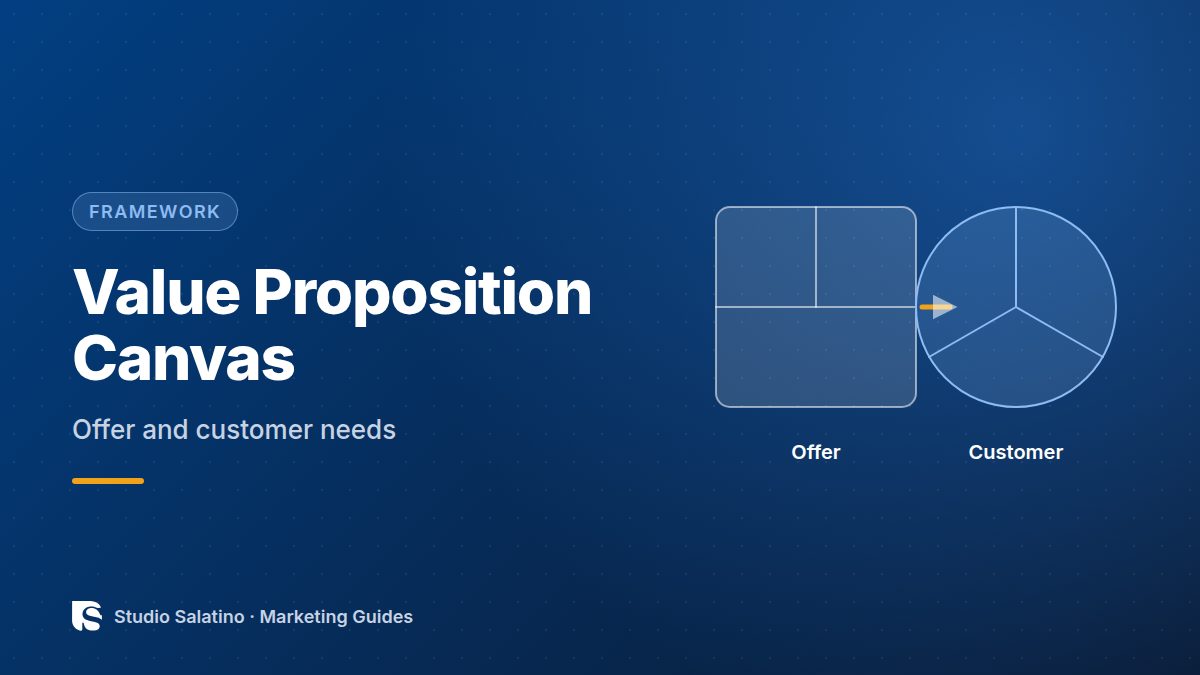
Two parts: customer profile and value map.
Jobs, pains and gains describe the customer.
You start from the customer, not from the offer.
One canvas for each customer segment.
How to apply it, step by step
Choose a customer segment
One canvas per segment: different customers have different needs.
Fill in the customer profile
Jobs to be done, pains and expected gains, based on interviews and data.
Fill in the value map
Products and services, how they relieve pains and how they create gains.
Check the fit
Link every important pain and gain to a response in your offer.
Write the value proposition
Turn the strongest matches into a clear, verifiable promise.
What it is for
The Value Proposition Canvas compares the customer profile with the value map of the offer. It helps you check that your products and services genuinely respond to what the customer is looking for, instead of listing features they care little about.
Customer profile
Jobs to be done: what they are trying to get done.
Pains: the risks, costs and frustrations they come up against.
Gains: the results they want.
Value map
Products and services: what the business offers.
Pain relievers: which pains it removes or reduces.
Gain creators: which results it makes possible.
An example: the accountancy firm
The customer, a small business owner, has to meet tax deadlines (job), worries about penalties and wasted time (pains) and would like to know in advance how much tax they will pay (gains). The firm responds with a shared calendar of deadlines (pain relieved) and a quarterly tax estimate (gain created). This becomes the promise to communicate.
Mistakes to avoid
Starting from the offer instead of the customer.
Listing every possible pain instead of the ones customers feel most.
Promising gains you cannot prove.
Frequently asked questions
What is the Value Proposition Canvas?
A tool that compares what the customer is looking for (jobs, pains, expected gains) with what the offer provides, to build a convincing value proposition.
How does it differ from the Business Model Canvas?
The Business Model Canvas describes the whole business model in nine building blocks; the Value Proposition Canvas looks in depth at two of them: customer segments and value proposition.
What are jobs, pains and gains?
The tasks the customer wants to get done, the problems and frustrations they come up against, and the results they want to achieve.
Every partnership starts with a conversation. The first two steps are free and with no obligation: they help us understand whether our method is right for your business.
1
Fill in the requestOne minute: your name, company and how to reach you.
2
Activate your accessAn email with a button takes you to the client area. Then the consultant sends you the discovery questionnaire: about 10 minutes, even in several sittings.
3
Free discovery callA 45-minute video call with the consultant to see whether and how we can help you.